
High Frequency Facial for Acne: How It Works
What a high-frequency wand does, what the one lab study on acne bacteria found, the precautions device makers list, and JH Beauty's acne options.
What Is a High Frequency Facial?
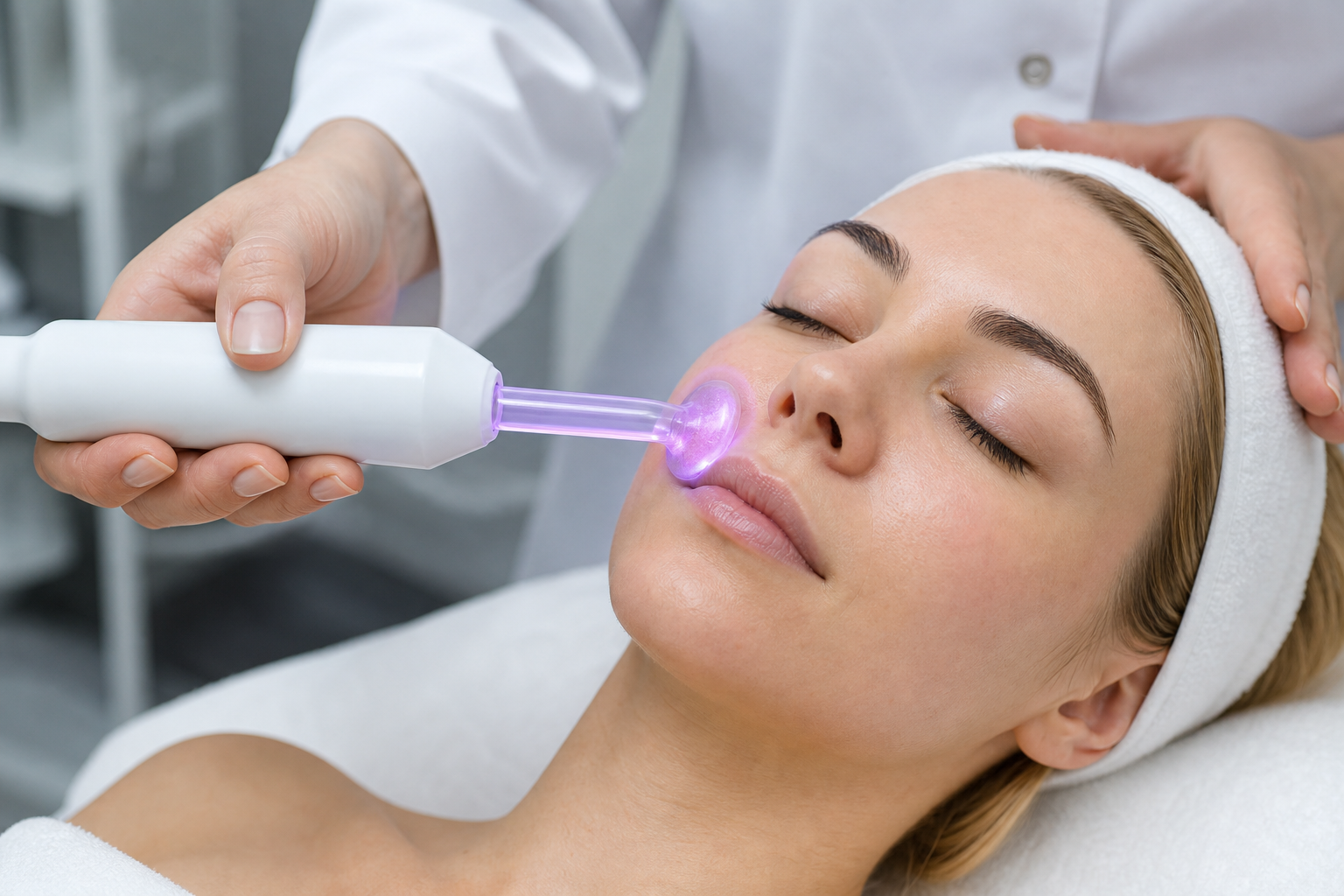
A high frequency facial uses a handheld wand that passes a low-level electrical current through a gas-filled glass electrode held against the skin. It is marketed for breakouts, and in one laboratory study a high-frequency device reduced acne bacteria on lab plates; the researchers proposed ozone, which the device gave off, as the likely mechanism but did not isolate it as the cause. That study was done on lab plates, not people, and its authors say clinical testing is still needed, so there is no solid evidence yet that high frequency helps acne in human skin.
High frequency is not a service on JH Beauty's menu. This guide explains what the device is, what the research does and doesn't show, and the precautions device makers list, so you can ask good questions wherever you book. If you are in Sunnyvale and want professional help with breakouts, JH Beauty's acne-related options are at the end.
A Very Old Device
High frequency is not new. According to the cosmetic-science historian at Cosmetics and Skin, the "Violet Ray" vacuum electrode was developed by Frederick Finch Strong in 1896, went into commercial production in 1903, and by the 1920s high-frequency machines were found in beauty salons as well as medical and dental clinics. Home models followed after the First World War. The historical glass electrodes were filled with mercury vapour, neon or argon gas, though most simply held air in a partial vacuum, and the strength of the vacuum changed the colour of the glow.
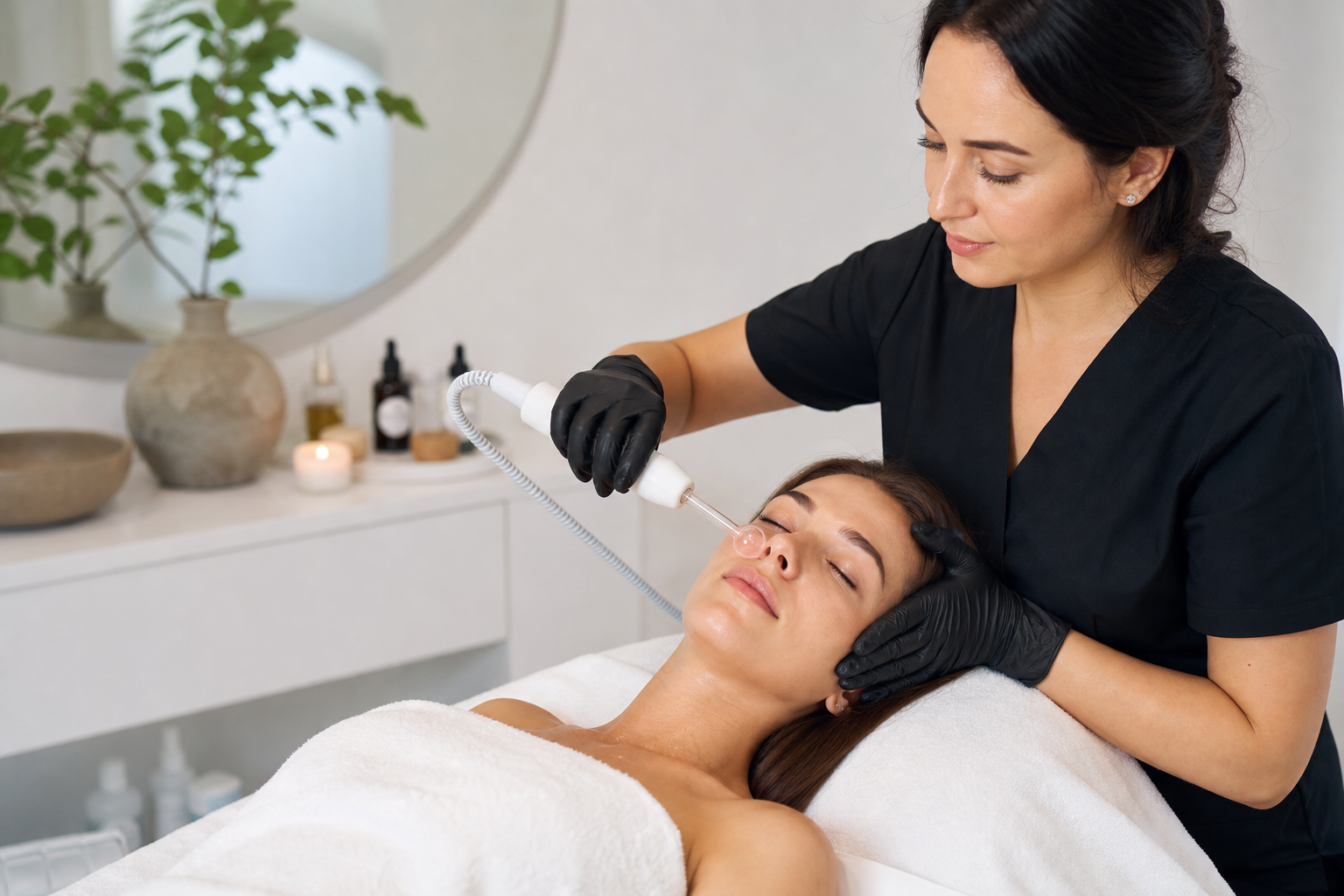
Today's wands work on the same principle. The user manual for one consumer wand, the NuDerma, describes it as sending "a low-level electrical current that passes through a glass electrode (also called a tube) filled with inert gas." Different tube shapes are sold for broad areas and for spot use.
Electrodes and Direct Application: What Beauty Training Describes
Much of what people search about high frequency comes from esthetics training, where two questions come up again and again: which application uses ozone for a germicidal effect, and which electrode suits acne.
Direct application is the one linked to ozone. Cosmetics and Skin describes direct high frequency as the operator holding the glass electrode and moving it upwards and outwards over the client's face. If a small gap is left, sparking between the electrode and the skin ionises the air and produces ozone, and that sparking was used in the past to treat pimples and other blemishes. In the indirect method (the "Viennese massage"), the client holds a saturator electrode while the operator massages the face with their hands.
Electrodes differ by shape and by gas. The historical kit included a bulb electrode for face and body work, the saturator for indirect treatments, a rake for the scalp and a fulguration electrode that concentrated a spark. Modern home wands are often sold with a small spot tube for blemishes; the NuDerma manual, for example, says you can tap the spot tube on a blemish several times or hold it there for 2–3 seconds. Tubes also glow different colours depending on the gas and vacuum inside. We found no clinical study comparing electrode shapes or gases for acne or occasional breakouts, so treat any claim that one colour or tube "works" for acne as unproven.
What the Research Shows
The most directly relevant study is a 2022 laboratory paper in Anais Brasileiros de Dermatologia, "High-frequency devices effect in vitro: promising approach in the treatment of acne vulgaris?" (Frommherz et al.). The authors start from the problem: high frequency "claims antimicrobial effects on acne skin, but solid data on its efficacy and mechanism of action is lacking."
Using a commercial device, they exposed skin bacteria, fungi and the acne bacterium (P. acnes, now called Cutibacterium acnes) to high frequency on agar plates. Treatment significantly reduced almost every bacterial and fungal species they tested, including P. acnes, compared with untreated plates. They saw no heat build-up on thermal imaging, and measured rising ozone in a closed room while the device ran, which led them to suggest ozone is the likely antimicrobial mechanism.
The limits matter as much as the result. The paper states: "The experiments were performed in vitro only. To assess clinical effects further in vivo experiments are necessary." Acne also isn't simply a surface infection: the AAD's acne guidelines recommend treatments that work in different ways, including topical retinoids to help unclog pores and reduce inflammation and benzoyl peroxide to reduce acne-causing bacteria. A wand that kills bacteria on a lab plate has not been shown to do any of that in skin, and there is no evidence on how it compares with those treatments.
About the Ozone
High-frequency devices can give off ozone. In the 2022 study, with the device switched fully on in a closed room of about 10.5 cubic meters, ozone reached 0.015 ppm after 10 minutes and kept rising, to 0.090 ppm after 50 minutes. The authors note that ozone in high concentrations (usually above 0.1 ppm) over prolonged periods may be harmful. Those numbers came from one device, run at full power in one closed room, and don't tell you what a particular salon or home wand produces. What they do show is that ozone built up the longer the device ran.
Precautions Device Makers List
Because high frequency is an electrical device, its manufacturers publish warnings. The NuDerma manual, for example, says:
- Stop using it if you have any adverse reaction such as an allergic response, swelling, skin discoloration, extreme redness, hyperpigmentation, or unusual pain.
- Don't use it with a pacemaker, neuro-stimulator or any implanted electronic device; ask your physician first if you use a body-worn device such as an insulin pump, and a dental professional if you have braces or permanent metal retainers.
- Don't use it if you are or might be pregnant; consult a physician first if breastfeeding.
- Ask your physician first if you have high or low blood pressure, a heart condition, epilepsy or a seizure disorder.
- Ask a dermatologist first if you have any diagnosed skin condition, and don't use it on skin cancer, suspicious lesions, cuts, abrasions, infections, bruising, swelling or skin that lacks sensation.
- Keep it away from oil-based or alcohol-based products and combustible liquids or gases.
The same manual limits sessions to five minutes, every other day, keeps the wand moving at 10–15 seconds maximum per area, and says a spot tube can be tapped on a blemish or held for 2–3 seconds. Those are one manufacturer's instructions for one device. If you use a wand at home, follow the manual for your model; if you have one used on you in a studio, ask the provider what device and settings they use.
High Frequency and Acne Medicine
If you have acne that over-the-counter products haven't controlled, the evidence-backed route is medical. The AAD guidelines strongly recommend topical benzoyl peroxide, topical retinoids (such as adapalene, tretinoin, tazarotene and trifarotene), and oral or topical antibiotics, with isotretinoin for severe acne or acne that hasn't responded to standard treatment. The same guidelines found the evidence insufficient to recommend procedures such as chemical peels and laser and light-based devices; the 2022 laboratory paper describes solid data on high frequency's efficacy as lacking.
If you are using a prescription retinoid or other acne medicine, the AAD's retinoid page advises building up gradually from low-strength formulas to avoid irritating your skin, and notes retinoids can make skin more sensitive to the sun. Tell anyone treating your skin what you use, and ask your prescriber before pausing or combining anything.
And whatever you try, the AAD's advice on popping pimples holds: squeezing can push the contents deeper and increase inflammation, risks infection from the bacteria on your hands, and can lead to permanent acne scars.
Home Wand or Professional Care?
Home high-frequency wands are sold widely, and the laboratory study above used a commercially available device. We found no published comparison of home and salon wands for acne. What a professional appointment can add is someone who looks at your skin and chooses a treatment for it. What a home wand requires is following its manual exactly, including cleaning the glass tube (the NuDerma manual says to use a soft cloth and a small amount of rubbing alcohol) and respecting the session limits.
If your acne is painful, deep, leaving scars, or not responding after several weeks of drugstore treatment, see a dermatologist. The AAD suggests giving a drugstore acne treatment 4 to 6 weeks before seeing a dermatologist.
Active Acne Treatment in Sunnyvale: JH Beauty's Options
JH Beauty doesn't offer high frequency. If you're looking for professional facial care for breakout-prone skin nearby, the two menu options that fit are:
- European Deep Cleaning Facial — $168, 75 minutes. JH Beauty suggests it as the starting point for blackheads and congestion.
- Chemical Peeling Series Treatment (Acne, Anti-aging, Lightening) — $278, 90 minutes, for the face or back.
The menu also has the Italian DPL PhotoTherapy ($288, 75 minutes, face or back), but it is listed as a skin rejuvenation treatment, not an acne treatment. If you are interested in it, ask at your appointment whether it suits your skin.
These are cosmetic treatments, not acne medicine. For painful, deep or scarring acne, the AAD's evidence-backed treatments come from a dermatologist. If you're under a dermatologist's care, agree on any facial or peel with your dermatologist and with the studio first. Compare the options on our acne facials in Sunnyvale page. JH Beauty is at 525 W Remington Dr, Suite 102, Sunnyvale, open Tuesday through Sunday, 10:45 AM to 8 PM; call +1-650-784-6076.
FAQ: High Frequency Facials for Acne
Does high frequency kill acne bacteria?
In a 2022 laboratory study it significantly reduced acne bacteria and other skin microbes on agar plates. The experiments were in vitro only, and the authors say studies in people are needed to know whether it helps acne in real skin.
Which high frequency application uses ozone for a germicidal effect?
Direct application. The electrode is moved over the skin, and sparking across a small gap ionises the air and produces ozone, which was historically used on pimples and blemishes. In the indirect method, the client holds a saturator electrode while the face is massaged by hand.
Which type of electrode is used for acne and occasional breakouts?
Home wands are often sold with a small spot tube for blemishes, and older kits used a bulb electrode for facial work. No clinical study we found compares electrode shapes or gases for acne, so no electrode has been shown to work better than another.
Where can I get active acne treatment near me in Sunnyvale?
For medical treatment, see a dermatologist, especially for painful, deep or scarring acne. For professional facial care for breakout-prone skin, JH Beauty at 525 W Remington Dr offers the European Deep Cleaning Facial ($168, 75 minutes) and the Chemical Peeling Series (Acne, Anti-aging, Lightening) ($278, 90 minutes).
Does high frequency hurt?
Sensations vary with the device and setting. Manufacturers such as NuDerma tell users to start at the lowest setting and to stop if they feel unusual pain or notice swelling, extreme redness or skin discoloration.
Does high frequency produce ozone?
It can. In one laboratory measurement, a device running at full power in a small closed room produced ozone levels that rose the longer it ran. Follow your device's session limits.
Who shouldn't use high frequency?
Device manuals such as NuDerma's list pacemakers and other implanted electronic devices, pregnancy, and broken, infected or suspicious skin as reasons not to use it, and advise asking a doctor first with heart conditions, blood-pressure problems, epilepsy or a diagnosed skin condition.
Can I use high frequency with tretinoin or other acne medicine?
We found no research on combining them. The AAD advises introducing retinoids gradually to avoid irritating your skin, so ask the doctor who prescribed your medicine before adding any device, and follow their instructions.
Does JH Beauty offer high frequency facials?
No. For breakout-prone skin, JH Beauty's menu options are the European Deep Cleaning Facial ($168, 75 minutes) and the Chemical Peeling Series ($278, 90 minutes).
About the author
Ruby
Owner and Lead Esthetician, J.H Beauty
Owner of JH BEAUTY, a skincare studio in Sunnyvale, CA offering advanced facial treatments, scalp care, and body management using technologies from Japan, Korea, Switzerland, and Italy.