
RF Skin Tightening vs. Microneedling: Which Tightens Skin?
RF skin tightening firms sagging skin with heat, no downtime. Microneedling resurfaces scars and texture with 24-48hr recovery. Compare cost and results.
If you are searching for skin tightening: plain microneedling improves texture and scars but does little for sagging. Radiofrequency (RF) is what tightens. RF skin tightening delivers the heat alone; RF microneedling delivers it through the needles, so one session works on laxity and texture together. The comparison below covers all three.
Short answer: RF skin tightening is better for sagging, jawline definition, and loose skin. Microneedling is better for acne scars, large pores, uneven texture, and hyperpigmentation. They target different skin layers, so many clients get the best results by combining both. Here's the full breakdown.
RF Skin Tightening vs. Microneedling: Two Different Approaches to Anti-Aging
Both RF skin tightening and microneedling stimulate collagen production, but that's where the similarity ends. They use different mechanisms, target different skin depths, require different recovery windows, and solve different problems. Choosing the wrong one won't hurt you, but it will waste your time and money on a treatment that wasn't designed for your specific concern.
At JH Beauty in Sunnyvale, we offer both treatments as part of our comprehensive anti-aging treatment menu. Our RF V-Shape Lifting uses radiofrequency energy to tighten and contour sagging skin. Our microneedling treatments create controlled micro-injuries to resurface texture, fade scars, and shrink pores. We see clients every week who aren't sure which one they need, and the answer almost always comes down to one question: is your primary concern sagging or surface damage?
This guide covers how each treatment works at a cellular level, what the clinical evidence says about results, realistic timelines for improvement, downtime differences, and which skin types respond best. We've updated all referenced studies to 2024-2026 data and included combination strategies that JH Beauty's estheticians use for clients who need both. For additional anti-aging options tailored to Sunnyvale clients, explore our guide to 7 Anti-Aging Treatments That Actually Work.
How RF Skin Tightening Works
Radiofrequency skin tightening delivers controlled thermal energy into the dermis, the layer of skin where collagen and elastin fibers live. The RF handpiece heats tissue to 40-42°C, a temperature range that causes existing collagen fibers to contract immediately while triggering your body's wound-healing response to produce new collagen over the following weeks.
At JH Beauty, our RF V-Shape Lifting treatment focuses specifically on facial contouring. It's most effective for jawline definition, jowl reduction, nasolabial fold softening, and overall skin laxity on the cheeks and neck. The handpiece glides across the skin in steady passes while an integrated temperature monitor ensures the dermis stays in the optimal heating range. Most clients describe the sensation as a warm stone massage. There's no puncturing, no bleeding, and no anesthesia needed.
A typical session takes 40-60 minutes. Most clients need 4-6 sessions spaced about one week apart for full results, with maintenance treatments every 3-4 months afterward. A 2025 meta-analysis in Dermatologic Surgery reviewing 22 RF studies found an average patient satisfaction rate of 84% for non-invasive RF skin tightening, with clinically measured improvements of 25-35% in skin laxity after a complete series. Results appear in two phases: an immediate subtle lift from collagen fiber contraction, and a gradual firming effect over 4-12 weeks as new collagen matures.
RF is safe for all Fitzpatrick skin types (I-VI), which is a significant advantage over some laser treatments that carry higher risk for darker skin tones. There's virtually zero downtime. Mild redness fades within 1-2 hours, and you can apply makeup the same day.
How Microneedling Works
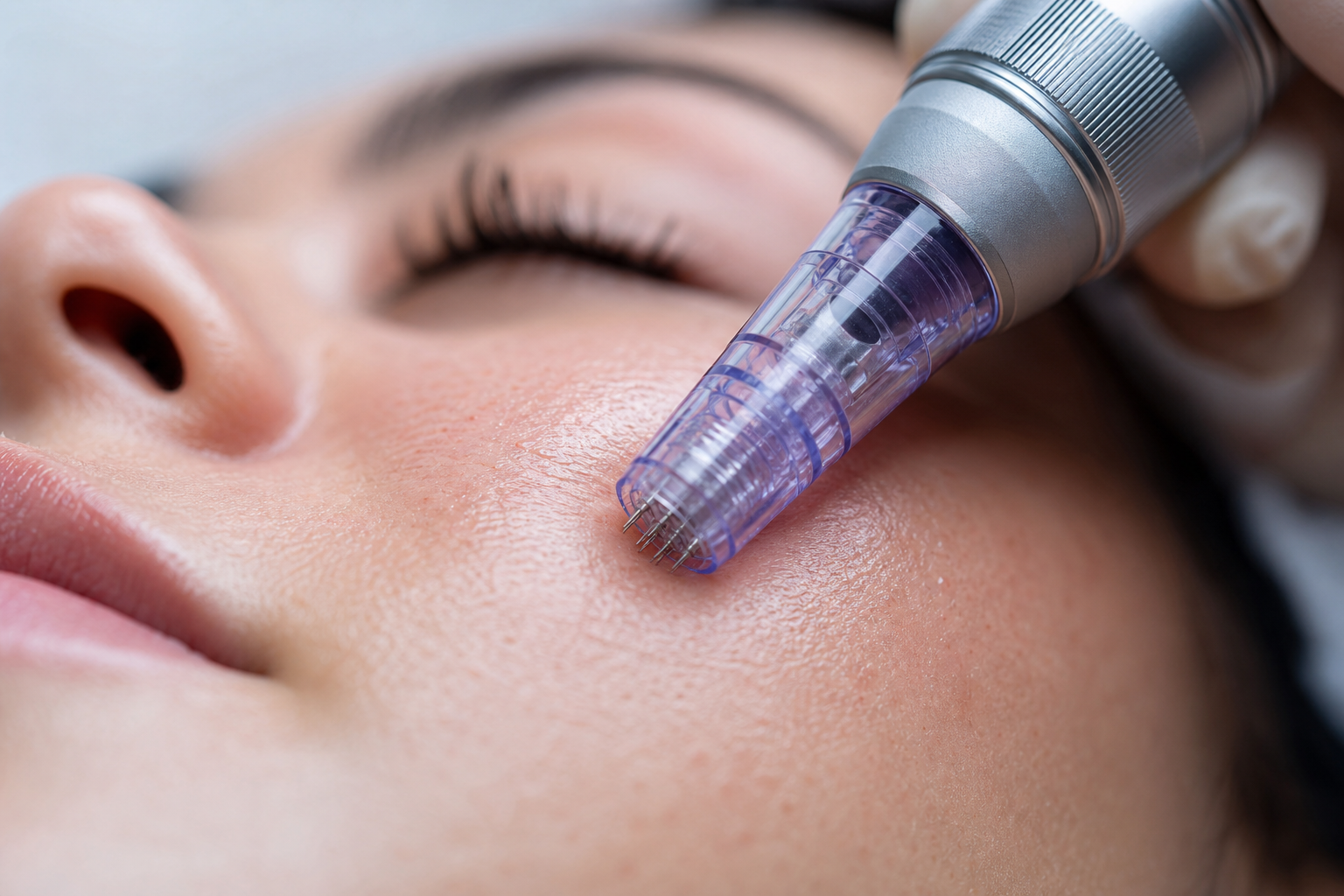
Microneedling takes the opposite approach. Instead of heat, it uses a device fitted with ultra-fine needles (typically 0.5-2.5mm in depth) to create thousands of controlled micro-punctures in the skin's surface. Each tiny wound triggers your body's natural repair cascade: platelets rush to the site, growth factors are released, and new collagen and elastin are synthesized over the following weeks. This process is called collagen induction therapy (CIT), and it's been used in dermatology since the late 1990s.
The evidence base is strong and continues to grow. A 2025 systematic review in the Journal of Clinical and Aesthetic Dermatology analyzed 34 controlled trials and found that microneedling improved acne scar severity scores by 51-68% after 3-4 sessions. It's also effective for fine lines, enlarged pores, uneven skin texture, hyperpigmentation, and stretch marks. A separate 2024 study in Dermatologic Therapy found that microneedling combined with topical vitamin C reduced melasma severity by 44% over 12 weeks.
At JH Beauty, our microneedling treatments use professional-grade devices with adjustable needle depths. We customize the depth based on the treatment area: shallower passes (0.5mm) for delicate under-eye skin, deeper passes (1.5-2.0mm) for acne scarring on the cheeks. A numbing cream is applied 20-30 minutes before the procedure, so discomfort is minimal. Most clients call it a mild scratching sensation, about a 3-4 out of 10 on the pain scale. For clients specifically targeting acne, our DPL Light Therapy treatment offers a complementary approach that can be combined with microneedling for enhanced results.
Sessions run 45-60 minutes including numbing time. You'll look red and slightly swollen afterward, similar to a moderate sunburn, for about 24-48 hours. Full healing takes around 5 days. For optimal results, we recommend 3-6 sessions spaced 4 weeks apart. New collagen matures over 4-6 weeks after each session, so the improvements are cumulative and build steadily through your treatment series.
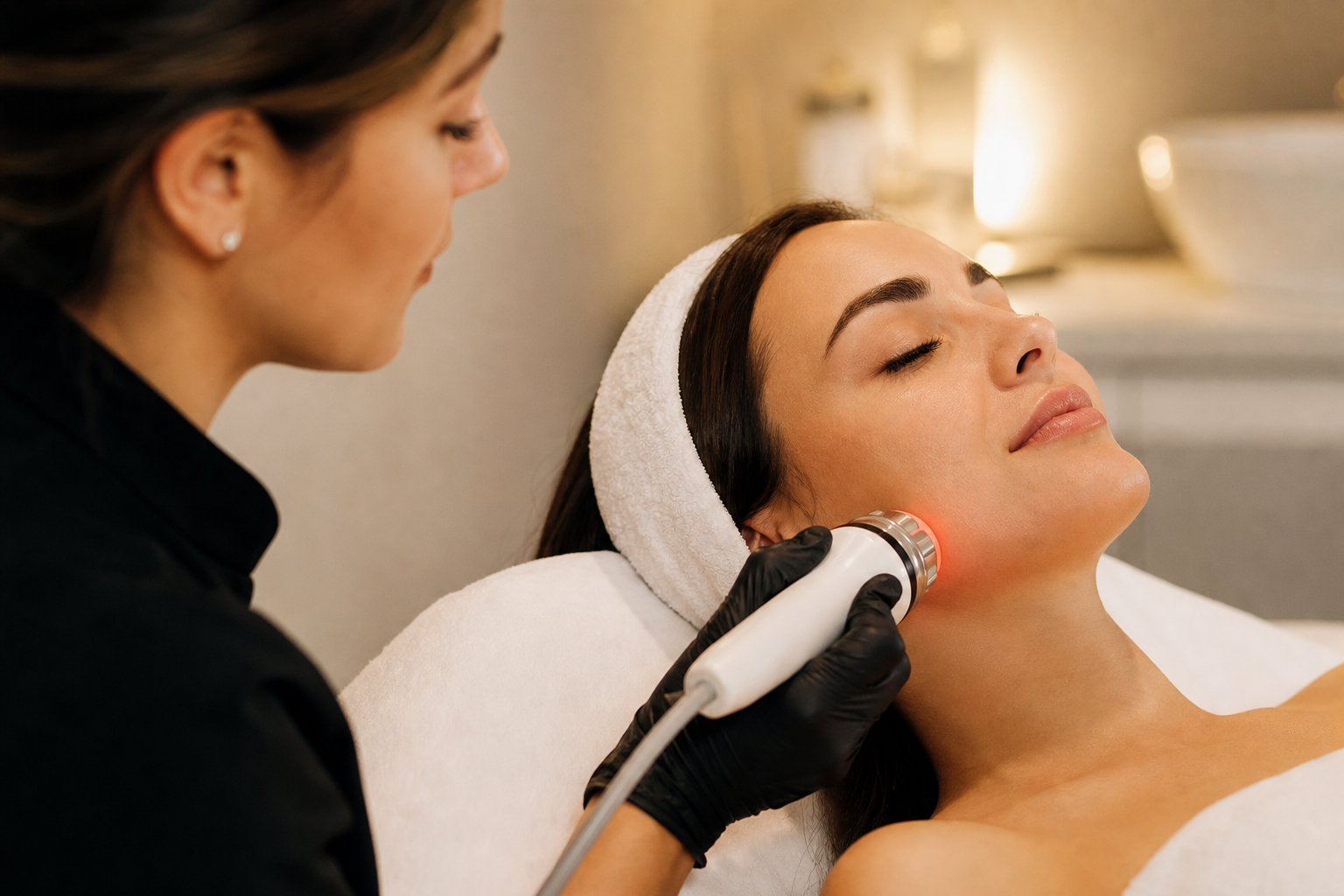
RF skin tightening uses controlled heat to contract collagen fibers and stimulate new collagen production in the dermis.
Side-by-Side Comparison: RF vs. Microneedling
Here's a direct comparison across the factors that matter most when you're deciding between RF skin tightening and microneedling:
- Primary mechanism: RF uses thermal energy to contract existing collagen and trigger remodeling in the dermis. Microneedling creates controlled micro-injuries in the epidermis and upper dermis to stimulate fresh collagen synthesis from scratch.
- Best for sagging and laxity: RF wins. It's designed to tighten loose skin, define the jawline, and reduce jowls. Microneedling won't meaningfully lift sagging tissue.
- Best for scars and texture: Microneedling wins. It excels at acne scarring (51-68% improvement per clinical data), large pores, rough texture, and hyperpigmentation. RF doesn't target surface-level concerns effectively.
- Downtime: RF has virtually zero downtime. You can wear makeup the same day. Microneedling requires 24-48 hours of redness and swelling, with full healing in about 5 days.
- Pain level: RF feels like a warm massage (2/10). Microneedling with numbing cream is about a 3-4/10.
- Sessions needed: RF typically requires 4-6 weekly sessions. Microneedling requires 3-6 sessions spaced 4 weeks apart.
- Total treatment timeline: RF series completes in 4-6 weeks. Microneedling series takes 3-6 months due to the longer spacing between sessions.
- Results timeline: RF shows a subtle immediate lift, with peak results at 2-3 months. Microneedling results appear gradually over 4-6 weeks per session, building cumulatively.
- Safety across skin tones: Both are safe for all Fitzpatrick types (I-VI). Deeper microneedling on darker skin tones should be performed by an experienced provider to minimize post-inflammatory hyperpigmentation risk.
The bottom line: if your main concern is sagging and loss of contour, RF is your treatment. If your main concern is scarring, texture, or pores, microneedling is your treatment. If you have both concerns, ask your esthetician about a staged combination protocol.
When to Combine Both Treatments
At JH Beauty, we frequently design treatment plans that combine RF skin tightening and microneedling for clients who need both lift and surface refinement. The two treatments complement each other well because they target different tissue depths and address different aging mechanisms. Here's how we typically structure combination protocols:
Staged approach (most common): Start with a full RF series (4-6 weekly sessions) to address laxity and contouring first. Once the RF series is complete, transition into microneedling (3-4 sessions spaced 4 weeks apart) to refine texture, pores, and pigmentation. This staged approach works well because RF has zero downtime, so you can complete the lifting phase quickly without disrupting your schedule. Then you shift to microneedling when you can accommodate the few days of redness.
Alternating approach: Some clients prefer to alternate treatments monthly. For example: RF session in week 1, microneedling session in week 5, RF in week 9, microneedling in week 13, etc. This approach delivers both lifting and resurfacing simultaneously, but it extends the total timeline to about 6-8 months.
Same-day layering (advanced): For clients with significant sun damage and laxity, we can perform RF immediately followed by microneedling in the same session. The RF pre-heats the tissue, which some studies suggest may enhance microneedling's collagen response. Downtime is equivalent to microneedling alone (24-48 hours of redness). We reserve this protocol for clients who need aggressive results and can tolerate a more intensive treatment.
A 2025 split-face study published in Lasers in Surgery and Medicine compared RF alone, microneedling alone, and RF + microneedling combination treatments. The combination group showed 34% greater improvement in overall skin quality scores compared to either treatment alone at the 3-month follow-up. Patient satisfaction was also highest in the combination group (92% versus 79% for RF alone and 81% for microneedling alone).
If you're considering a combination approach, book a consultation at JH Beauty. Our estheticians will assess your skin's current condition, listen to your primary concerns, and recommend the most efficient treatment sequence for your goals and schedule.
Who Should NOT Get These Treatments
Both RF skin tightening and microneedling are extremely safe for most people, but there are a few contraindications to be aware of:
RF skin tightening is not recommended if you:
- Have metal implants or pacemakers in the treatment area (the electromagnetic energy can interfere with electronic devices)
- Are pregnant or breastfeeding (not due to proven risk, but due to lack of safety data)
- Have active skin infections, open wounds, or severe rosacea in the treatment area
- Have extremely thin or severely sun-damaged skin that can't tolerate heat safely
Microneedling is not recommended if you:
- Have active acne cysts or infections (wait until flare-ups calm down)
- Are on isotretinoin (Accutane) or have used it in the past 6 months (it impairs wound healing)
- Have keloid scarring tendency (microneedling could trigger abnormal scar formation)
- Are pregnant (theoretical risk only, but most providers avoid it)
- Have bleeding disorders or are on anticoagulant medications (higher bruising risk)
During your consultation at JH Beauty, your esthetician will review your full medical history and current skincare routine to confirm you're a safe candidate. If either treatment isn't appropriate for you right now, we'll recommend alternative options that can achieve similar results safely.
Cost Comparison and Value Analysis
Pricing for RF skin tightening and microneedling varies by geographic location, provider experience, and the specific technology used. Here's what you can expect in the Sunnyvale and greater Bay Area market in 2026:
RF skin tightening: Individual sessions typically range from $200-$450. A full treatment series (4-6 sessions) runs $800-$2,400. At JH Beauty, our RF V-Shape Lifting series is priced competitively within this range. Maintenance sessions every 3-4 months cost less than initial series pricing.
Microneedling: Individual sessions typically range from $250-$500 depending on treatment area and depth. A full treatment series (3-4 sessions) runs $750-$1,800. Add-ons like PRP (platelet-rich plasma), growth factor serums, or specialized post-treatment masks can increase the per-session cost by $150-$300.
Combination packages: Many med spas, including JH Beauty, offer bundled pricing if you commit to a full RF + microneedling treatment plan upfront. These packages typically save 15-25% compared to purchasing sessions individually.
When evaluating value, consider the total investment over time. RF requires ongoing maintenance every 3-4 months to sustain results, so your annual spend will be $600-$1,200 for maintenance after the initial series. Microneedling maintenance is less frequent—typically 1-2 sessions per year—so annual maintenance costs are lower ($250-$800).
Compare this to surgical options: a surgical facelift costs $15,000-$25,000 and lasts 7-10 years, while a full RF + microneedling program over 2 years (initial series + maintenance) costs roughly $2,500-$4,500. For many clients in their 30s-50s, non-invasive treatments offer better value because they deliver noticeable improvement without the cost, risk, and recovery time of surgery.
FAQ: RF Skin Tightening vs. Microneedling
Can I do just one treatment instead of a series?
You can, but results will be minimal and short-lived. Collagen remodeling requires multiple treatments to build cumulative improvement. A single RF or microneedling session will give you a temporary glow, but won't produce the structural changes that last.
How long do results last?
RF skin tightening results last 6-12 months with proper maintenance. Microneedling results can last 12-18 months or longer because you're building new collagen from scratch. Both treatments require periodic maintenance to counteract ongoing aging.
Which treatment hurts more?
RF is nearly painless (feels like a warm massage). Microneedling with numbing cream is tolerable for most people (3-4/10 discomfort level). If you have a very low pain threshold, microneedling might be uncomfortable despite numbing.
Can I combine these with Botox or fillers?
Yes. It's common to layer RF or microneedling with injectables. The general rule: wait 2 weeks after Botox or fillers before doing RF or microneedling in the same area. You can do injectables immediately after RF or microneedling once any swelling has resolved.
Will I see results after one session?
RF shows subtle immediate results (mild tightening) that improve over 2-3 months. Microneedling shows no immediate results—you'll look red and swollen for a few days, then see gradual improvement over 4-6 weeks as new collagen matures.
Which treatment is better for neck aging?
RF skin tightening is significantly more effective for neck laxity and horizontal neck lines. Microneedling can help with neck texture and crepiness, but won't tighten loose skin as effectively as RF.
Can I work out after these treatments?
After RF, you can resume normal activities immediately, including exercise. After microneedling, avoid sweating and gym workouts for 24-48 hours while the micro-channels in your skin heal.
Do I need to use special skincare products afterward?
After RF, return to your normal routine immediately. After microneedling, avoid active ingredients (retinol, acids, vitamin C) for 3-5 days and stick to gentle, hydrating products until redness resolves. Your esthetician will give you specific post-treatment instructions.
About the author
Ruby
Owner and Lead Esthetician, J.H Beauty
Owner of JH BEAUTY, a skincare studio in Palo Alto, CA offering advanced facial treatments, scalp care, and body management using technologies from Japan, Korea, Switzerland, and Italy.