
Korean Facial in Sunnyvale: What Makes It Different
What a Korean facial means at JH Beauty in Sunnyvale: the $238 Korean Style Rejuvenation, DPL, hydrogen Hydrofacial, RF and plasma treatments explained.
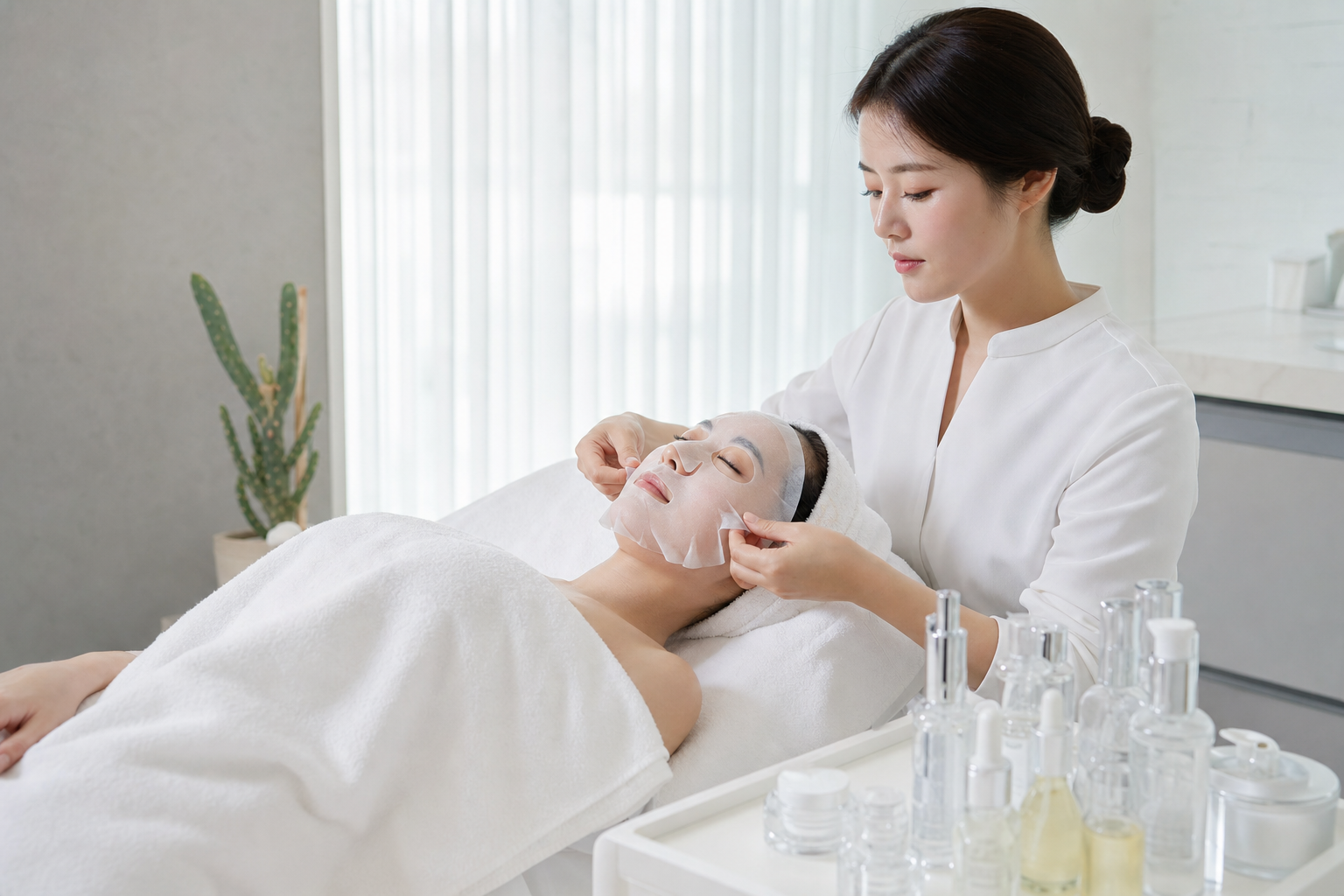
The name "Korean facial" on its own doesn't tell you which steps a studio includes, so look at the specific menu. At JH Beauty in Sunnyvale, it means the Korean Style Rejuvenation Skin Management ($238, 90 minutes), which JH suggests for hydration, dullness or sensitive skin, alongside device-based treatments such as Italian DPL PhotoTherapy and a hydrogen Hydrofacial. This guide explains what each of those actually is, what the menu says about it, and where the evidence is thin.
What Is a Korean Facial?
The name alone doesn't tell you which steps a particular studio includes, so it's more useful to look at what that studio's menu says the treatment involves, and to ask about anything the menu leaves out.
On JH Beauty's live menu, the Korean-style treatments sit under a heading that describes them as "Korean-style skin management and Nir-DPL milk-light therapy — the layered, hydration-first approach, done as a full treatment." The core service is the Korean Style Rejuvenation Skin Management (韩式水光肌焕肤柔润皮肤管理). JH Beauty's own booking advice is: "For hydration, dullness or sensitive skin, start with the Korean facial ($238, 90 minutes)."
The menu doesn't publish a step-by-step protocol for this treatment. If you want to know exactly what happens in the 90 minutes, which products are used and whether any device is involved, ask when you book; the answer can also depend on your skin that day.
For comparison, if your main concern is blackheads and congestion rather than dryness, JH Beauty points people to the European Deep Cleaning Facial ($168, 75 minutes) instead. For a broader look at anti-aging options, see our guide to anti-aging treatments in Sunnyvale.
The Device-Based Treatments on the Menu
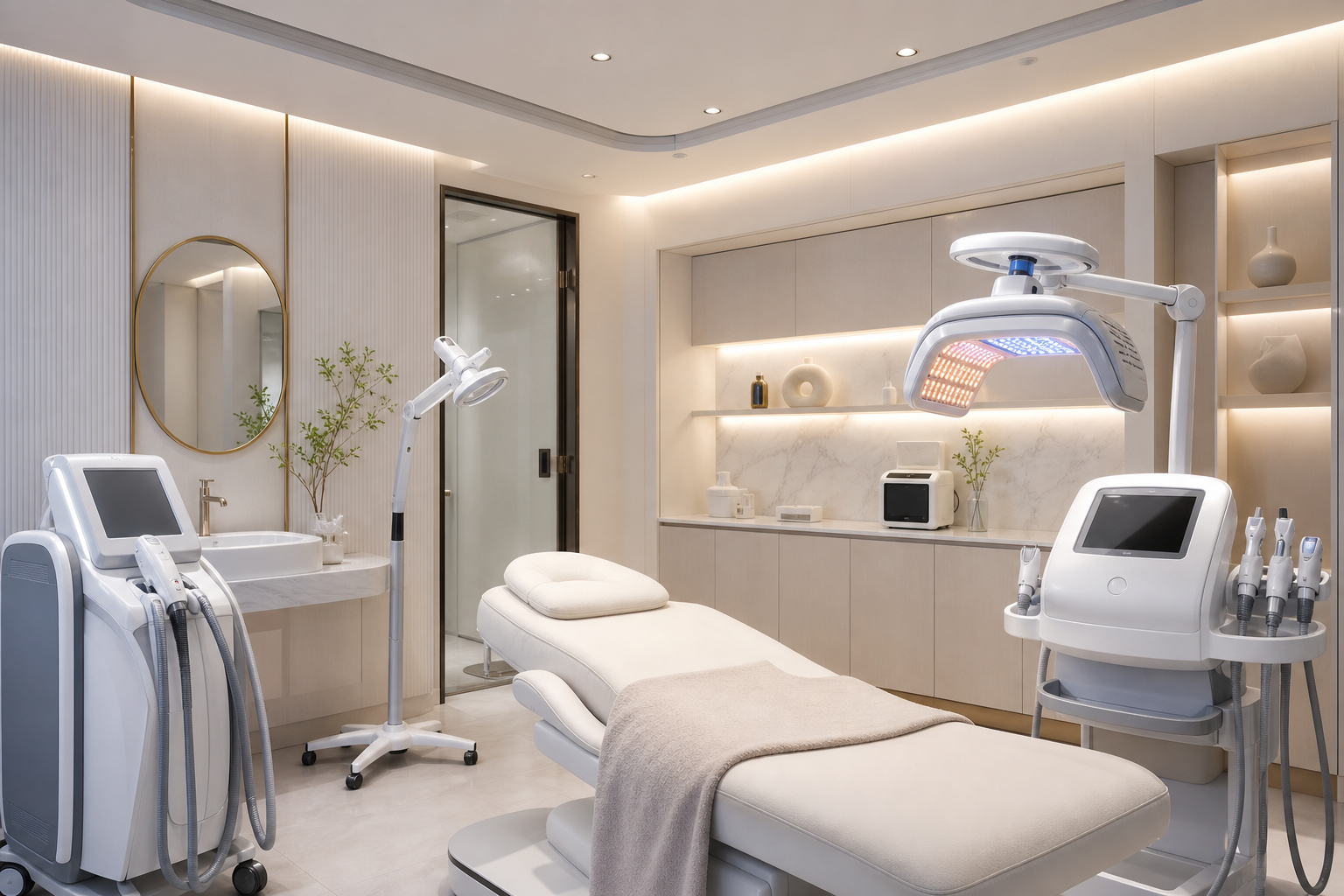
JH Beauty's menu lists several device-based treatments alongside its Korean-style facial. Here is what the menu says about each, plus what outside sources say where we could find them.
Italian DPL PhotoTherapy (Milk-Light)
The menu describes Italian DPL PhotoTherapy as an "Italian Nir/DPL Milk-Light PhotoFacial, available for both facial and back treatments," using "Gentle Pulse Light." It is $288 for a 75-minute booking.
DPL (delicate pulsed light) is a filtered form of pulsed light. A 2022 study in Lasers in Medical Science describes DPL as having "a narrow therapeutic spectrum (500-600 nm)" (Li et al.), and a 2025 retrospective study of 181 patients with sensitive skin reported lower sensitivity scores and reduced facial redness after low-energy DPL, with no obvious adverse effects recorded (Fu et al., Journal of Cosmetic Dermatology). This retrospective study had no untreated comparison group, and those researchers used their own devices and settings; JH Beauty's menu doesn't publish its device's wavelength. Our DPL light therapy for acne guide covers the acne research and the precautions medical sources list for pulsed light.
Hydrofacial (Japanese Hydrogen or Korean AbbasPlas)
The Hydrofacial [Japanese Hydrogen/or Korean AbbasPlas] is $358; confirm the session length when you book. The menu describes it as a "Hydrofacial [Hydrogen+Hydroveil] Treatment" designed around "Hydroimpact technology." There is also a Hydrofacial Express Option for Male at $288, booked as 90 minutes. The menu doesn't set out the treatment's steps, so ask what the session includes.
Plasmas & LDM Top Tech Therapy
The Plasmas & LDM Top Tech Therapy is $358, booked as 90 minutes. The menu describes it as incorporating "Japanese Plasma & Water Droplet Lifting Technology." JH Beauty notes that the cold plasma it uses "is not the plasma-pen procedure that leaves crusting."
RF Anti-aging V-Lifting Therapy
The RF Anti-aging V-Lifting Therapy is $278, booked as 90 minutes, and the menu says it features "Japanese RF (Radiofrequency) Mini-Thermage technology." JH Beauty describes it as the usual entry point for firmness and contour. Our RF skin tightening vs. microneedling article compares approaches (JH Beauty doesn't offer microneedling).
What JH Beauty Says to Expect
For its non-invasive anti-aging treatments (RF V-shape lifting, Japanese 6D, plasma and LDM, Cellcosmet and Quantus collagen lifting), JH Beauty's own guidance is that there is no downtime, that "skin may look slightly flushed for a few hours," and that "hydration and glow show first; firmness builds over several weeks across a series." Everyone's skin responds differently, so treat that as a general expectation rather than a promise, and tell your esthetician if anything feels uncomfortable during the session.
Before any facial, JH Beauty asks you to mention your skincare and recent treatments. Its guidance is not to book a facial while taking isotretinoin (Accutane) and to wait at least six months after finishing; prescription retinoids are usually fine if you stop applying them about five days beforehand and tell the studio what you use. If you've had Botox or fillers, say when at booking so energy-based treatments can be spaced around them.
After any facial that includes exfoliation or a light or heat device, sun protection is sensible. The American Academy of Dermatology recommends a broad-spectrum sunscreen with SPF 30 or higher. Follow the specific aftercare you're given.
Korean Facial Menu at JH Beauty
All prices and booking lengths below are from the current menu:
- Korean Style Rejuvenation Skin Management — $238, 90 minutes. JH Beauty's suggested starting point for hydration, dullness or sensitive skin.
- Italian DPL PhotoTherapy — $288, 75 minutes, face or back.
- Hydrofacial [Japanese Hydrogen/or Korean AbbasPlas] — $358 (confirm the session length when booking).
- Hydrofacial Express Option for Male — $288, 90 minutes.
- Plasmas & LDM Top Tech Therapy — $358, 90 minutes.
- RF Anti-aging V-Lifting Therapy — $278, 90 minutes.
The menu also has Japanese-inspired treatments. The Japanese 6D Luxury Anti-aging Skin Management ($258, 90 minutes) is described as "inspired by the meticulous methods of Japanese skincare and the prestigious Shonan Club." Our Korean vs. Japanese skincare article looks at how the two sets of treatments differ on the menu.
How Often, and What It Costs Over a Year
JH Beauty's general guidance is every four to six weeks for facials. There's no fixed number of sessions; ask what rhythm makes sense for your skin and goals.
To plan a budget, work out a yearly figure from your own schedule. A $238 Korean Style Rejuvenation Skin Management every four weeks is 13 visits, or $3,094 a year; every six weeks it's about nine visits, or $2,142. The European Deep Cleaning Facial at $168 every six weeks would be about $1,512. Facial treatments on the menu range from $168 to $398 (the Italy Quantus Thermal Remodeling), so the right choice depends on what you want each visit to do, not only on price.
JH Beauty is at 525 W Remington Dr, Suite 102, Sunnyvale, CA 94087, open Tuesday through Sunday, 10:45 AM to 8 PM. Call +1-650-784-6076, or see all options on our Korean facials in Sunnyvale page.
FAQ: Korean Facials in Sunnyvale
Is a Korean facial the same as a HydraFacial?
No. HydraFacial is a specific brand of device-based facial. "Korean facial" is a general label, and the name alone doesn't say which steps are included. JH Beauty's menu has its own Hydrofacial treatment (Japanese Hydrogen or Korean AbbasPlas, $358) as well as the Korean Style Rejuvenation Skin Management ($238, 90 minutes).
Does it hurt?
It depends on the treatment and on your skin. JH Beauty says its non-invasive anti-aging treatments have no downtime and that skin may look slightly flushed for a few hours. Tell your esthetician right away if anything is uncomfortable.
Can I use retinoids before a Korean facial?
JH Beauty's guidance is that prescription retinoids are usually fine if you stop applying them about five days beforehand and tell the studio what you use. Don't book a facial while on isotretinoin; wait at least six months after finishing.
Are Korean facials suitable for acne-prone skin?
Tell your esthetician about active breakouts when you book. JH Beauty's options for congested or breakout-prone skin include the European Deep Cleaning Facial, the Chemical Peeling Series and Italian DPL PhotoTherapy.
How often should I book?
JH Beauty's general guidance for facials is every four to six weeks. Ask at your appointment what suits your skin.
Can men book these treatments?
JH Beauty's menu includes a Hydrofacial Express Option for Male, $288 for a 90-minute booking. For the other treatments, the menu doesn't say who each is for, so call the studio at +1-650-784-6076 to confirm.
About the author
Ruby
Owner and Lead Esthetician, J.H Beauty
Owner of JH BEAUTY, a skincare studio in Sunnyvale, CA offering advanced facial treatments, scalp care, and body management using technologies from Japan, Korea, Switzerland, and Italy.