
Korean vs Japanese Skincare at JH Beauty
What K-beauty and J-beauty mean, how Korea and Japan regulate skincare claims, and which JH Beauty treatments carry each label.
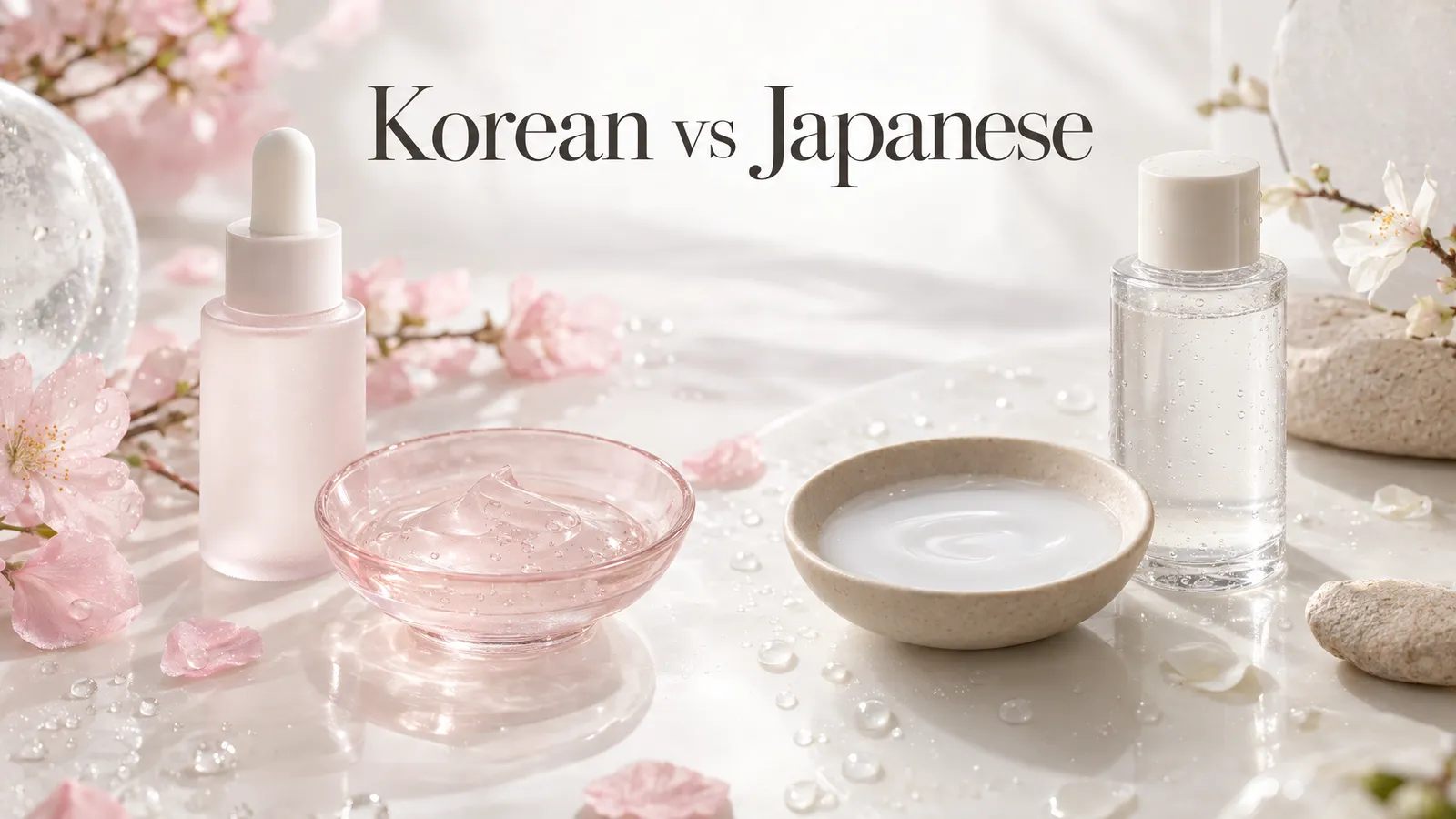
"Korean" and "Japanese" skincare are labels, not two regulated categories with fixed rules. They describe where a product, brand or treatment style comes from. At JH Beauty in Sunnyvale, the menu names both: a Korean-style rejuvenation facial, a Japanese 6D anti-aging treatment, a Hydrofacial offered with Japanese or Korean equipment, and more. The better question is usually what a treatment does for your skin, not which country it is associated with.
What the two labels usually mean
"K-beauty" is used for Korean skincare and makeup brands and the beauty culture around them. Wikipedia's overview of Korean beauty standards describes the ideal of "dewy" skin — "smooth, hydrated, clear, resilient, and shiny" — and lists blemish balm (BB) creams, color correction (CC) creams, serums, essences, ampoules, seaweed face masks and scrubs among the most popular products. The same article mentions "extensive skincare regimes, which often involve ten steps or more." That is where the familiar picture of layered, hydration-focused routines comes from.
"J-beauty" is used in the same loose way for Japanese brands. There is no official definition of either term, and plenty of generalizations about them — which country is more "minimal," more "gentle" or more "innovative" — are marketing shorthand rather than anything you can check. A single Korean or Japanese brand can make a ten-step routine or a one-bottle product. If you are choosing products, read the ingredient list and the label claims of the specific product in front of you rather than trusting the country on the box.
How Korea and Japan regulate skincare claims
One real difference between the two markets is how they handle products that make specific functional claims.
In South Korea, the Ministry of Food and Drug Safety (MFDS) has a category called "functional cosmetics" — products with functions such as whitening, wrinkle improvement or hair-loss reduction. According to the MFDS, a seller of a functional cosmetic "shall undergo an evaluation by the Minister of the Ministry of Food and Drug Safety (MFDS) or shall submit a report" for safety and effectiveness. Products whose active ingredients, functions and test methods match ones the MFDS has already notified or approved can go through the report route instead of a full evaluation. General cosmetics are different: the regulatory summary published by ChemLinked states that they "do not require pre-market registration or evaluation by the MFDS," though the responsible seller must make sure they comply with the rules before sale.
Japan has a category called quasi-drugs, which sits between cosmetics and medicines. Shiseido's own research release gives an example: it says its claim that "pure retinol" improves wrinkles was "recognized for the first time in Japan by the Ministry of Health, Labour and Welfare" in 2017, and that it is approved to use pure retinol as a quasi-drug active ingredient. In both countries, then, a product that makes a specific functional claim goes through a regulator in a way that an ordinary moisturizer does not.
Two well-documented examples of brand research
Brand research is easy to overstate, so here are two examples described in the companies' own words rather than as proof of anything country-wide.
SK-II and Pitera. SK-II says that "in the 1970s, scientists noticed the hands of elderly Japanese sake brewers looked younger than their age," which led to research on yeast fermentation. The company says it identified its ingredient, Pitera, from "350 kinds of yeast known at that time," and describes it as containing amino acids, vitamins, minerals and organic acids. These are the brand's own statements about its own ingredient.
Shiseido and retinol. Shiseido says it has more than 30 years of retinol research, and explains why that matters: pure retinol "is easily degraded by oxygen, heat, light, etc.," so keeping it stable in a formula takes work. Shiseido also notes that "it takes several weeks for the physiological changes of the skin to appear" — a useful reminder that retinol is not an overnight ingredient, whoever makes it.
Korean brands have their own research stories, and you will see ingredients such as snail mucin and fermented extracts in many K-beauty products. Whether any one of those products does what its label says depends on the product, not on the category.
Korean-style and Japanese-method treatments at JH Beauty
JH Beauty's menu uses country names to describe the style of a treatment or the origin of its equipment. Here is what the menu lists, with current prices and session lengths:
- Korean Style Rejuvenation Skin Management — $238, 90 minutes.
- Japanese 6D Luxury Anti-aging Skin Management — $258, 90 minutes. The menu describes it as inspired by the methods of Japanese skincare and the Shonan Club.
- Hydrofacial — $358, 90 minutes, offered with Japanese Hydrogen or Korean AbbasPlas equipment.
- RF Anti-aging V-Lifting Therapy — $278, 90 minutes; the menu describes it as using Japanese radiofrequency technology.
- Plasmas & LDM Top Tech Therapy — $358, 90 minutes; the menu names Japanese plasma and water-droplet lifting technology.
- For lashes, the menu lists a Japanese-style Classic Lash Extension ($168, 60 minutes) and Keratin Lash Lifting ($128, 60 minutes).
Not everything on the menu with an Asian-sounding name is Korean or Japanese. The Italian DPL PhotoTherapy ($288, 75 minutes, face or back) is listed as Italian, and there is more about it in our post on DPL light therapy. The menu also includes Swiss Cellcosmet facials and a European deep-cleaning facial, so country of origin is only one way to sort the options.
For more detail on the Japanese treatment, see our post on the Japanese 6D anti-aging facial.
How to choose between them
Start with your concern, then look at which treatments address it. JH Beauty's own booking guidance puts it this way: for hydration, dullness or sensitive skin, start with the Korean facial ($238, 90 minutes); for blackheads and congestion, the European deep cleaning facial ($168, 75 minutes); and for firmness and contour, RF V-shape lifting ($278, 90 minutes) is the usual entry point. The Japanese 6D and plasma treatments sit on the anti-aging side of the menu alongside RF.
A few practical points help more than the country label:
- Tell the studio what you use at home, especially prescription retinoids or isotretinoin, and any recent cosmetic procedures, so a treatment can be planned around them.
- Ask what a treatment involves — which device, how long, and what to expect afterwards — before you book something new.
- Judge by your own skin over time, not by a single session or a photo online.
For other options in the area, our local skincare guide covers Sunnyvale more broadly.
Borrowing from both at home
If you like the idea of layering a Korean essence under a Japanese moisturizer, there is no rule against mixing brands from different countries. What the American Academy of Dermatology (AAD) emphasizes is simpler: it calls sunscreen and moisturizer "the two most-effective anti-aging products you can buy." It recommends a sunscreen that is broad spectrum, SPF 30 or higher and water resistant, and suggests looking for products labeled hypoallergenic and non-comedogenic.
The AAD also advises patience — "give sunscreen and moisturizer a few weeks to work. Then look at your skin" — and realistic expectations, noting that anti-aging products "deliver modest results." That applies whether the bottle came from Seoul, Tokyo or anywhere else. Add one new product at a time, so that if something irritates your skin you know which one it was.
FAQ: Korean vs Japanese Skincare
Are Korean beauty products suitable for all skin types?
There is no single answer, because "Korean beauty" covers thousands of products with very different formulas. Check the ingredients and label of the specific product, and if your skin is sensitive or you use prescription treatments, ask a dermatologist or skincare professional before adding it.
Is Japanese skincare gentler than Korean skincare?
Not as a rule. Gentleness depends on the formula of the individual product, not the country it comes from. Both markets sell mild moisturizers and strong active products.
Are Korean or Japanese skincare products regulated?
Both countries have a stricter route for products with specific functional claims. In Korea, "functional cosmetics" such as whitening or anti-wrinkle products go through an MFDS evaluation or report; general cosmetics need no pre-market registration. In Japan, quasi-drugs are a separate category — Shiseido, for example, says its retinol wrinkle claim was recognized by Japan's Ministry of Health, Labour and Welfare.
Which JH Beauty treatments are Korean and which are Japanese?
Korean Style Rejuvenation Skin Management ($238, 90 minutes) is the Korean-style facial. The Japanese 6D Luxury Anti-aging Skin Management ($258, 90 minutes), RF Anti-aging V-Lifting Therapy ($278, 90 minutes) and Plasmas & LDM Top Tech Therapy ($358, 90 minutes) are listed with Japanese methods or technology. The Hydrofacial ($358, 90 minutes) uses Japanese Hydrogen or Korean AbbasPlas equipment.
Which one should I book first?
Book by concern rather than country. JH Beauty suggests the Korean facial for hydration, dullness or sensitive skin, and RF V-shape lifting for firmness and contour. See the full menu for every option.
Pricing and booking: see current prices and session lengths for Korean facials in Sunnyvale.
About the author
Ruby
Owner and Lead Esthetician, J.H Beauty
Owner of JH BEAUTY, a skincare studio in Sunnyvale, CA offering advanced facial treatments, scalp care, and body management using technologies from Japan, Korea, Switzerland, and Italy.