
Vitamin C Facial in Sunnyvale: Brightening Treatment Guide
What research on topical vitamin C shows, what to ask before booking, and how JH Beauty's $218 Vital-C facial compares with other brightening options.
What Is a Vitamin C Facial?
A vitamin C facial is a professional facial built around topical vitamin C, an antioxidant studied for its effects on pigmentation, collagen and sun-related skin damage. At JH Beauty in Sunnyvale, the Vital-C Brightening Antioxidants Facial Treatment is $218 for a 75-minute booking, and the menu describes it as part of the Professional-C portfolio. The research on vitamin C comes mostly from daily skincare products, so it can't tell you exactly what a single facial will do.
Below is what that research says, where its limits are, what to check before booking, and how the Vital-C facial compares with other brightening options on the JH Beauty menu.
What the Research on Topical Vitamin C Shows
A useful overview is a 2017 review in the Journal of Clinical and Aesthetic Dermatology, "Topical Vitamin C and the Skin: Mechanisms of Action and Clinical Applications" (Al-Niaimi and Chiang). Its summary of the evidence:
- Antioxidant and photoprotection: the review describes vitamin C as "one of the most powerful antioxidants in the skin" and says it "has been shown to protect against photoaging, ultraviolet-induced immunosuppression, and photocarcinogenesis."
- Collagen: it has an anti-aging effect "by increasing collagen synthesis, stabilizing collagen fibers, and decreasing collagen degradation."
- Pigmentation: "It decreases melanin formation, thereby reducing pigmentation."
- Vitamin E: vitamin C "is the primary replenisher of vitamin E and works synergistically with vitamin E in the protection against oxidative damage."
The review also covers derivative forms such as ascorbyl-6-palmitate and magnesium ascorbyl phosphate alongside ascorbic acid itself. Its conclusion comes with an important caveat: "clinical studies on the efficacy of topical formulations of vitamin C remain limited, and the challenge lies in finding the most stable and permeable formulation in achieving the optimal results."
In other words, how well vitamin C works depends a great deal on the formulation, and most of what's known is about products people use regularly at home. A professional facial is a single session every few weeks, so it's reasonable to think of it as a complement to daily care rather than a substitute for it.
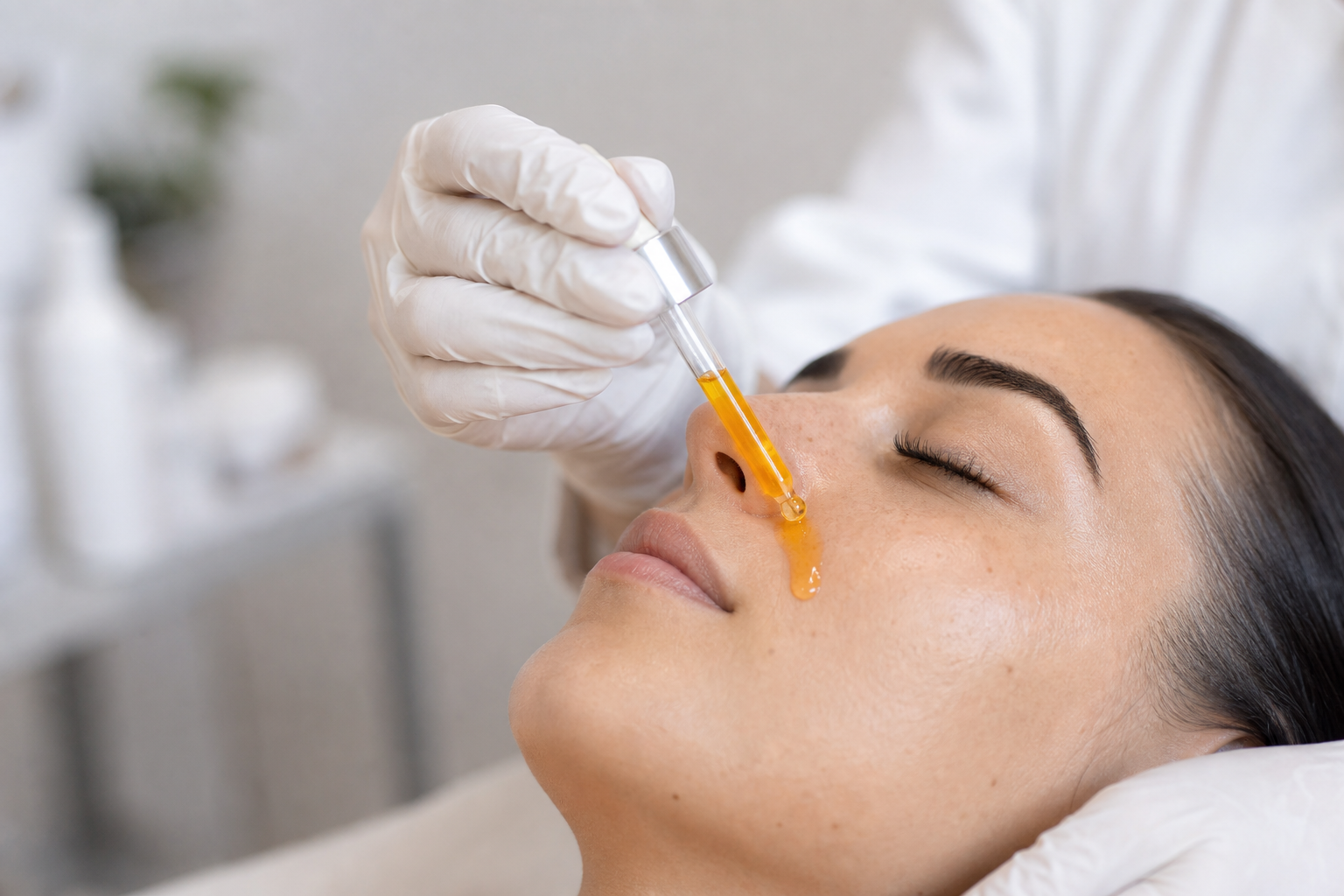
Illustration: a serum being applied with a dropper during a facial.
What the Vital-C Facial Includes
JH Beauty's menu gives the name, the price, the booking length and the product line, but not a step-by-step protocol. If you want to know which steps and products are included, whether there's any exfoliation, and what the vitamin C concentration or form is, ask when you book. Those details can also depend on your skin on the day.
Useful questions to ask:
- Which Professional-C products are used, and what form of vitamin C do they contain?
- Is there an exfoliation step, and if so, what kind?
- Is the treatment suitable if my skin is sensitive, reactive or breaking out right now?
- What aftercare do you recommend, and when can I go back to my usual products?
Who Should Check First
Sensitive or reactive skin. Everyone's skin responds differently, and a facial involves more than one product. If you have rosacea, eczema, very sensitive skin, or active breakouts, say so when booking. If breakouts are your main concern, our acne facials in Sunnyvale page covers the options JH Beauty suggests first.
Retinoids and isotretinoin. JH Beauty's own guidance for facials is not to book while taking isotretinoin (Accutane) and to wait at least six months after finishing. Prescription retinoids are usually fine if you stop applying them about five days beforehand and tell the studio what you use.
Recent procedures. If you've recently had a peel, a laser or light treatment, or injectables, mention when. JH Beauty asks clients who have had Botox or fillers to say when at booking so energy-based treatments can be spaced around them.
Pregnancy. The American Academy of Dermatology's pregnancy skin care advice quotes a dermatologist recommending a vitamin C product in the morning to help prevent and treat changes to skin color. That supports vitamin C skincare in pregnancy, not every product in a facial: the same page lists retinoids and hydroquinone to avoid and says to limit salicylic acid above 2%. Tell the studio you're pregnant, ask what the facial uses, and see our facials while pregnant guide.
Vitamin C Facial vs. Other Brightening Options
JH Beauty's menu has several treatments people consider for dullness and uneven tone. Prices and booking lengths are from the current menu:
- Vital-C Brightening Antioxidants Facial — $218, 75 minutes; built on the Professional-C line.
- Chemical Peeling Series Treatment (Acne, Anti-aging, Lightening) — $278, 90 minutes, for the face or back. The AAD says healing after a light peel takes 1 to 7 days, with redness and then scaling that can last 3 to 7 days, and that 3 to 5 peels may be needed.
- Cellcosmet Whitening & Collagen Facial Treatment — $288, 90 minutes; the menu describes a "VitaCell & Collagen Whitening Booster."
- Italian DPL PhotoTherapy — $288, 75 minutes, a pulsed-light treatment for the face or back. Our DPL guide covers what the research shows and who should avoid pulsed light.
For melasma specifically, our melasma treatment guide looks at vitamin C and peels together. Melasma is worth raising with a dermatologist, especially if it's new or spreading.
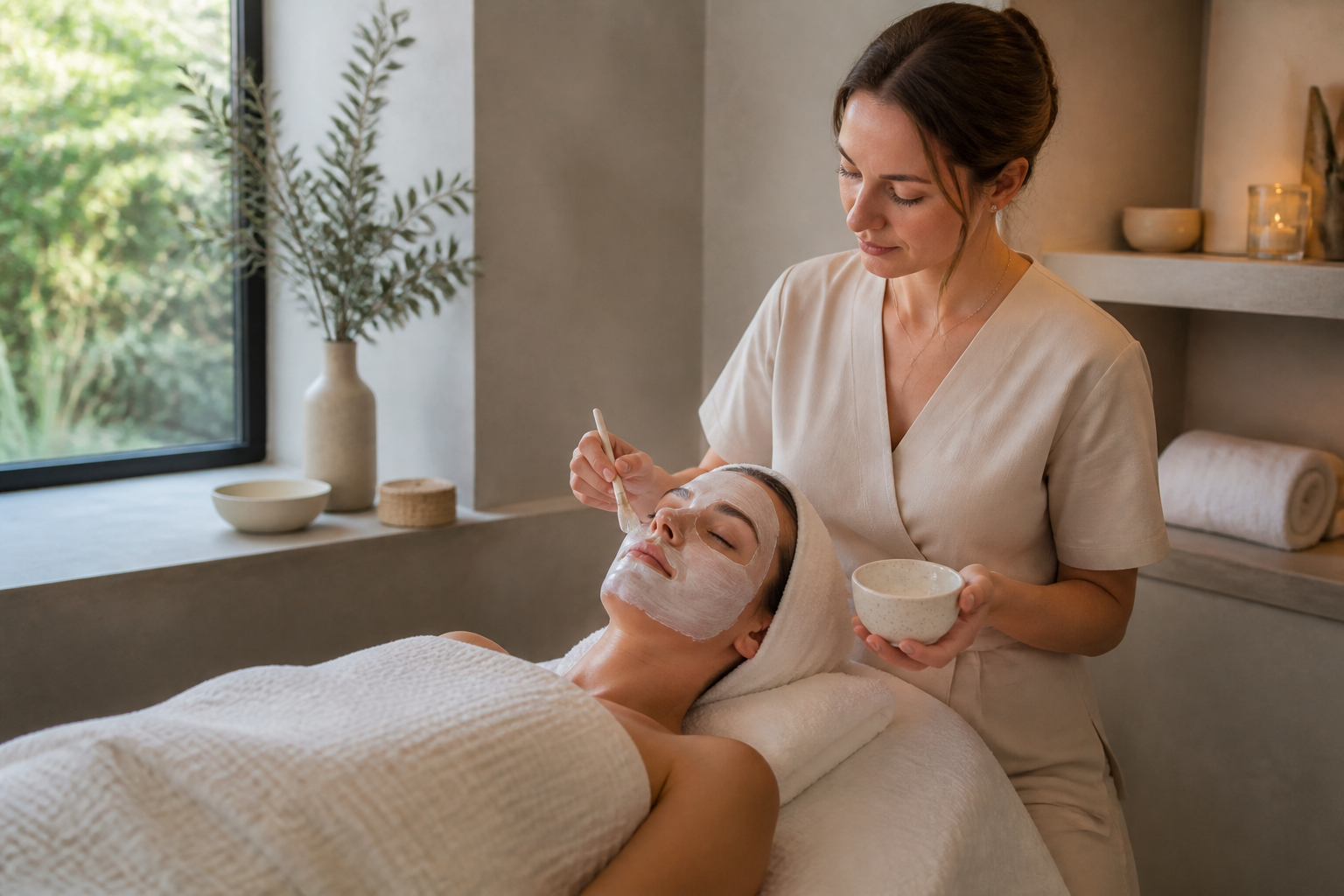
Illustration: a mask being brushed on during a facial.
Sun Protection Comes First
The 2017 review highlights vitamin C's role in protecting against ultraviolet damage, but that doesn't replace sunscreen. The American Academy of Dermatology recommends choosing a broad-spectrum sunscreen with an SPF of 30 or higher, which protects against both UVA and UVB rays. If you're working on dark spots or uneven tone, daily sun protection is the part of the routine you control every day, between appointments.
After your facial, follow the aftercare your esthetician gives you. If your skin feels irritated afterward, keep your routine simple and contact the studio.
Cost and How Often
JH Beauty's general guidance is every four to six weeks for facials. The number of sessions that suits you depends on your skin and goals, so ask what rhythm makes sense for you. To budget, multiply by your own schedule: at $218, a visit every four weeks is 13 visits, or $2,834 a year; every six weeks is about nine visits, or $1,962.
JH Beauty is at 525 W Remington Dr, Suite 102, Sunnyvale, CA 94087, open Tuesday through Sunday, 10:45 AM to 8 PM. Call +1-650-784-6076, or see the full menu.
FAQ: Vitamin C Facials
What does vitamin C do for skin?
A 2017 review in the Journal of Clinical and Aesthetic Dermatology reports that topical vitamin C protects against photoaging, increases collagen synthesis and decreases melanin formation. It also notes that clinical studies of specific topical formulations remain limited.
How much is a vitamin C facial at JH Beauty?
The Vital-C Brightening Antioxidants Facial Treatment is $218 for a 75-minute booking. The menu says it is part of the Professional-C portfolio.
How often should I get a vitamin C facial?
JH Beauty's general guidance for facials is every four to six weeks. Ask at your appointment what suits your skin and goals, and keep up daily sunscreen in between.
Does a vitamin C facial hurt?
Responses vary with your skin and the products used. Tell your esthetician beforehand if your skin is sensitive, and say so straight away if anything stings or feels uncomfortable.
Can I get a vitamin C facial while pregnant?
The AAD's pregnancy advice includes a dermatologist's recommendation of a vitamin C product in the morning, but a facial uses other products too. Tell the studio you're pregnant, ask what the treatment contains, and check with your OB-GYN.
Is a facial better than a vitamin C serum at home?
They're different. Most vitamin C research is on regularly used topical products, and the 2017 review says the formulation matters. A facial is an occasional professional treatment; a home product is daily. Ask your esthetician how the two fit together for your skin.
About the author
Ruby
Owner and Lead Esthetician, J.H Beauty
Owner of JH BEAUTY, a skincare studio in Sunnyvale, CA offering advanced facial treatments, scalp care, and body management using technologies from Japan, Korea, Switzerland, and Italy.